
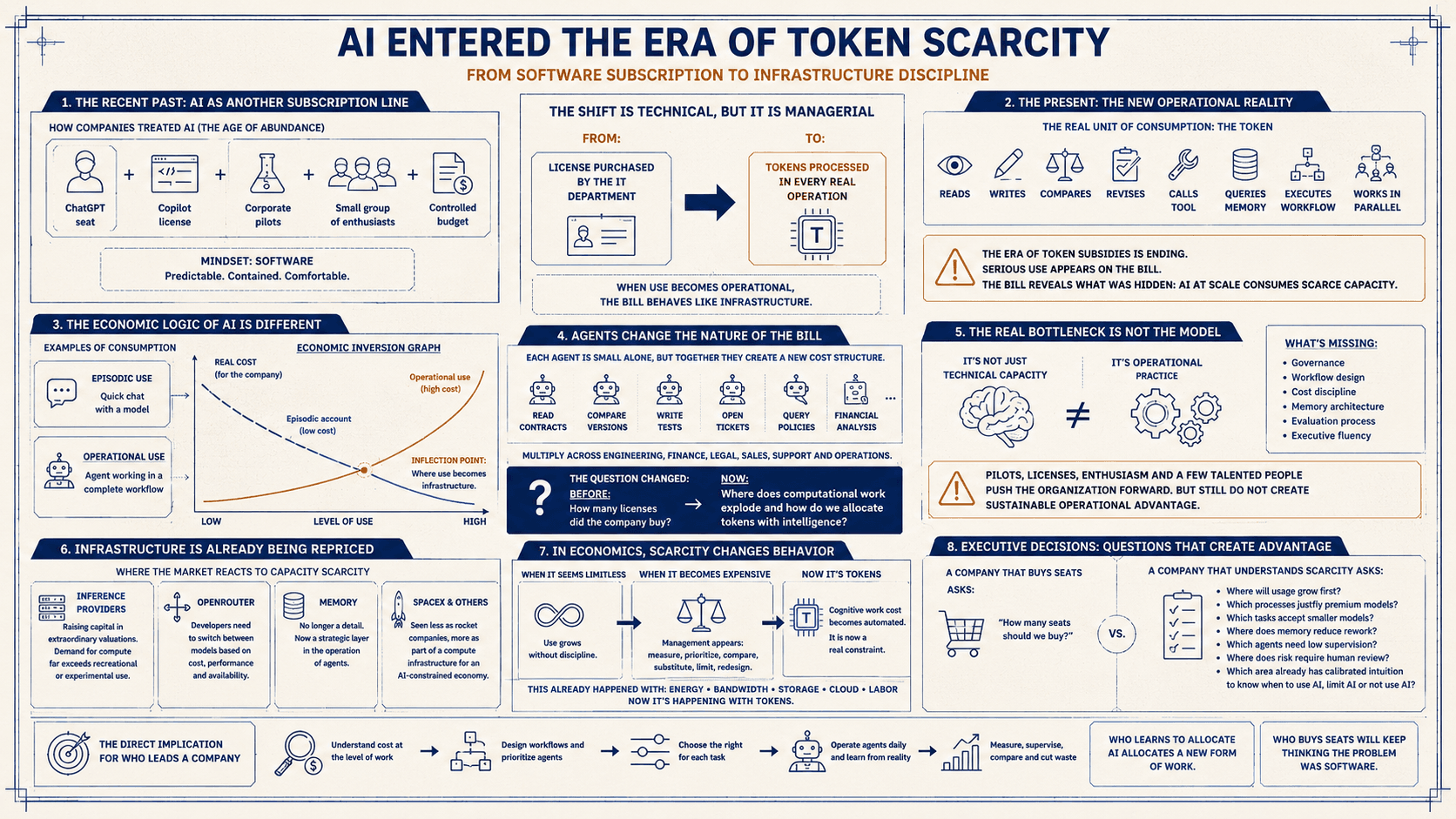
For two years, many companies treated AI as another subscription line. A ChatGPT seat here. A Copilot license there. A few corporate pilots, a small group of enthusiasts, a controlled budget.
That phase is over. AI has entered the era of token scarcity.
The shift looks technical, but it is managerial. The real unit of AI consumption is not the license bought by the technology department. It is the token processed every time a model reads, writes, compares, reviews, calls a tool, consults memory, executes a flow or works in parallel with other agents. As long as usage was episodic, the bill looked like software. When usage becomes operations, the bill starts behaving like infrastructure.
The token became an operational constraint
The initial confusion was understandable. Executives bought categories. They bought CRM, ERP, BI, collaboration, security. When generative AI appeared, it mentally entered the same shelf. There was a new class of software, a monthly plan, a license per user and a promise of productivity.
Predictable. Contained. Comfortable.
But the economics of AI are different. A quick conversation with a model and an autonomous programming session that lasts for hours cannot have the same real price. A prompt to summarize a document and an agent that reads an entire repository, writes code, runs tests, reviews errors and tries again consume different orders of magnitude of computation.
That is why the market movement started to change. GitHub Copilot is moving toward usage-based pricing. Google may announce lower nominal prices for Gemini and, at the same time, add usage limits and overage charges. Companies that have spent a few months beyond the pilot phase are beginning to discover the cost shock of real adoption.
The era of token subsidies is ending. During the user acquisition phase, much of the cost remained hidden, absorbed by vendors willing to gain market share. Now serious usage appears on the invoice. And the invoice reveals what had been concealed: AI at scale consumes scarce capacity.
Agents change the nature of the bill
The central point is the agent.
An employee who asks ChatGPT something a few times a day generates one type of consumption. An agent that works for hours inside an operational flow generates another. One reads contracts. Another compares versions. Another writes tests. Another opens tickets. Another consults internal policies. Another prepares a financial analysis. Each one looks small when seen in isolation. Together, they form a new cost structure.
Multiply this by engineering, finance, legal, sales, customer service and operations. The question stops being how many licenses the company bought. The question becomes where computational work explodes, which flows justify high token consumption, which tasks should migrate to cheaper models, which agents need human supervision and which teams learn faster to operate in this new operational logic.
Yes, better models matter. But the bottleneck for companies is not only model capability. It sits between the technical capacity available and the operational practice installed. If the model were enough, engineers allocated directly to customers would not be one of the most disputed roles in the technology market. Demand for these professionals reveals something else: most companies still do not know how to turn agents into productive routine.
Governance, workflow design, cost discipline, memory architecture, evaluation process and executive fluency are missing. Pilots, licenses, enthusiasm and a few talented people pushing the organization forward are abundant. This combination produces movement. It still does not produce durable operational advantage.
Infrastructure is already being repriced
Not by chance, the infrastructure layer is beginning to be repriced. Inference providers raise capital at extraordinary market valuations because the market sees that demand for computation tends to grow far beyond recreational or experimental use. OpenRouter gains relevance because developers need to switch between models according to cost, performance and availability. Memory vendors stop being a technical detail and begin to occupy a strategic position in agent operations.
Even SpaceX is starting to be observed from another angle. Less as a rocket company, more as a possible part of computing infrastructure for an AI economy limited by capacity. This may feel distant to the board of a traditional company. Even so, the message is simple: when the constraint sits in infrastructure, cost appears where there used to be a promise of abundance.
In economics, scarcity changes behavior. While something seems unlimited, usage grows with little discipline. When the resource becomes expensive, management appears. The company starts to measure, prioritize, compare, substitute, limit and redesign. That happened with energy, bandwidth, storage, cloud and specialized labor. Now it is starting to happen with tokens.
The difference is that tokens are not only a technology cost. They are the cost of automated cognitive work. When one agent reads a contract, when another debugs software, when another prepares a commercial proposal, token consumption is directly connected to the way the company executes work. As a consequence, token discipline belongs to the CEO, the CFO and the COO as much as to the CTIO.
The board needs to change the question
A company that treats AI as tool implementation asks how many seats it should buy. A company that understands token scarcity asks better questions.
Where will utilization grow first? Which processes have enough return to justify more expensive models? Which tasks accept smaller models? Where does memory reduce rework? Which agents can operate with low supervision? Where does risk require human review? Which area has already developed calibrated intuition to know when to use AI, when to limit AI and when not to use AI?
These are management questions before they are technology questions. The expensive mistake will be delegating them too early to the technical layer, as if the subject were only architecture. Architecture matters. But the decision about allocating a scarce resource is an executive decision. It always was.
If you run a company, the implication is direct. The next phase of AI will not reward those who bought more licenses, nor those who ran more internal demonstrations. It will reward those who understand cost at the level of work. Those who know which flows deserve agents, which deserve simple automation, which deserve experienced people with AI beside them and which should remain linear for a while.
Operational advantage will come from this friction with real work. Operating agents daily, noticing where they break, adjusting prompts, writing memory files, creating evaluations, switching models, cutting useless consumption and learning to relate tokens spent to outcomes produced. Measured. Supervised. Compared. Cut.
The CFO will notice the bill. The COO will inherit the complexity. The CEO will be held accountable for the operational logic that allowed, or prevented, the company from learning how to use AI without turning apparent abundance into structural waste.
Treat tokens as an operational constraint before the market teaches that lesson through the invoice. The company that learns to allocate AI learns to allocate a new form of work. The one that buys seats will continue thinking the problem was software.