
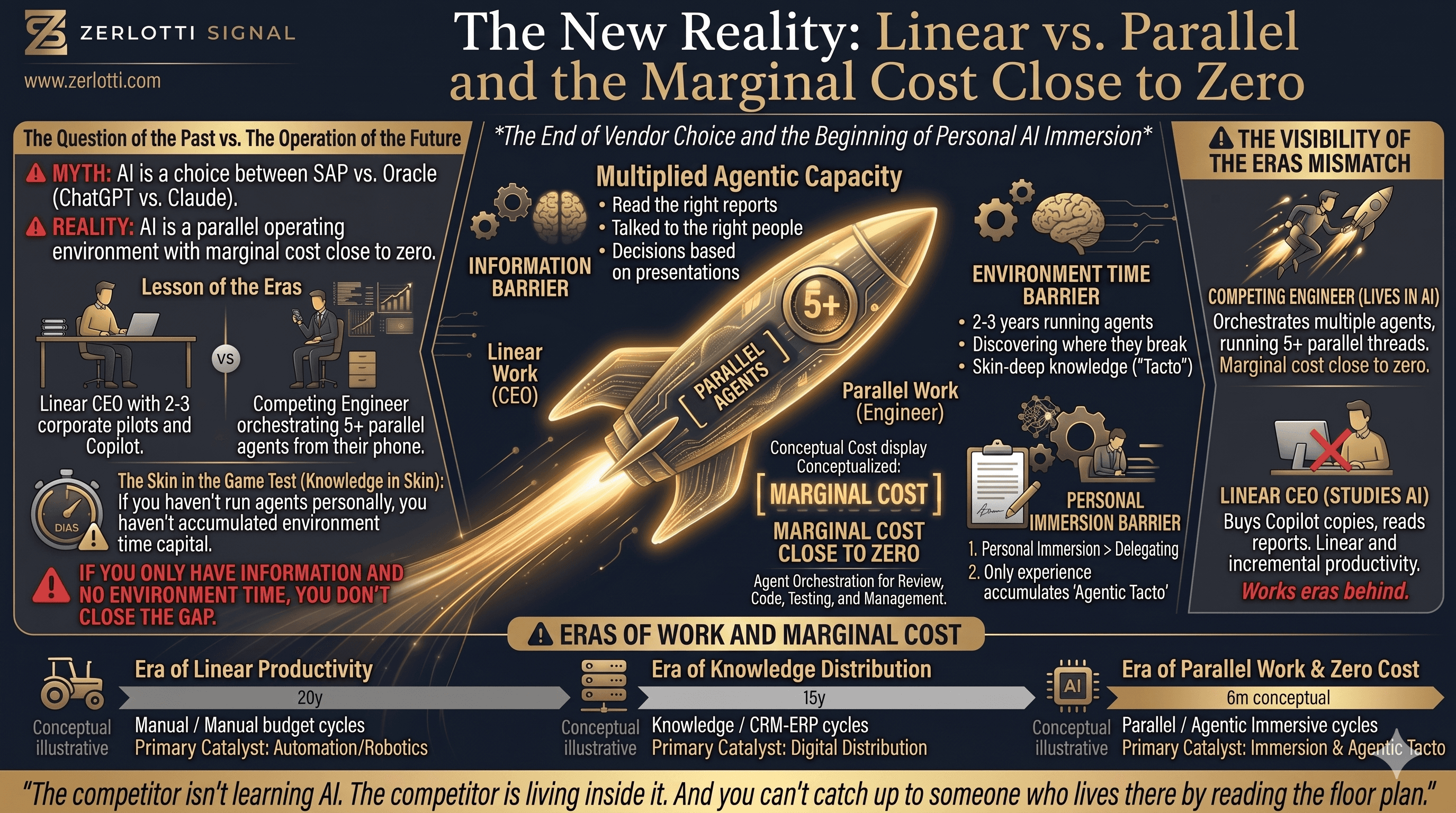
Two weeks ago, I had dinner with the CEO of a company with 180 million reais in revenue. In the middle of the second course, he lowered his voice a little and asked: "Rodrigo, what is the difference between ChatGPT and Claude these days?" The question sounded simple. It revealed a distance of eras.
I smiled. I answered calmly. He thanked me, asked two more polite questions and changed the subject. I went home thinking about the contrast between that table, with silverware and a white tablecloth, and the engineering team of one of his direct competitors, somewhere in the world, supervising agents in parallel from a phone.
The scene matters because it captures a transition many boards still treat as an IT subject. The executive at the table was asking about products. The competitor was already operating in another operational logic. While one compared interfaces, the other reorganized work.
That difference is beginning to separate companies in a way less visible than a new factory, an acquisition or a capital round, but potentially more profound. The dispute now passes through the type of work the organization can produce, at what speed, with what marginal cost and with what level of human judgment on top.
The innocent question reveals the wrong mental map
The question about ChatGPT and Claude sounds innocent because it fits a known mental map. For decades, companies bought categories: ERP, CRM, BI, ITSM. It was predictable. Procurable. Auditable. Comfortable.
For that reason, it makes sense for a CEO formed in that world to ask which tool is better. He learned that enterprise technology enters through the vendor door, passes through the budget, becomes a project, meets resistance, receives training and, little by little, gets incorporated into the operation. Like comparing Oracle and SAP, Salesforce and HubSpot. That model worked well enough to build entire careers and entire companies.
The problem begins when ChatGPT and Claude are treated like ERP and CRM. They are part of a new class of software that creates an operational environment. Inside that environment, people write, research, code, review, compare, debug, test, draft and decide with units of work that did not exist before. The interface is only the visible part. The change sits in what becomes delegable.
Not by chance, the recent moves by the large AI companies point in the same direction. OpenAI brought Codex to the phone. Google placed Gemini inside Android, Chrome, laptops and glasses. Anthropic positioned Claude to automate legal work and small business operations. UiPath started talking about agentic automation. Tempo launched a product called AI Head of Growth, with the explicit ambition of occupying a role in the org chart, with KPIs.
None of this fits well inside the question "which vendor should we choose?". The correct question is: what can my competitor already do today that was impossible eighteen months ago? And what does that reveal about the distance he has already opened?
The competitor operates in parallel work
The pattern is familiar. The CEO probably has two or three AI pilots running in the company. Perhaps he bought corporate Copilot licenses and received a well-made presentation on priority use cases. Perhaps he will speak at the next strategic offsite about productivity, automation and artificial intelligence, using the right terms. All of this is reasonable. But none of it attacks the real problem.
Meanwhile, the competitor's engineer works with another logic of efficiency. On a phone, he supervises five AI agents in parallel. One debugs a legacy system. Another writes tests. Another reviews pull requests. Another combs through internal documentation. Another drafts the email he will send to the manager in an hour.
This is the decisive passage. The CEO continues to operate in linear work, as he always has: one decision, one meeting, one analysis at a time. But the competitor's engineer operates in parallel work, with marginal cost close to zero. One engineer starts coordinating five fronts. One analyst starts covering ten. One product becomes a platform for continuous experimentation.
In economics, this changes the productivity question. The most important question is not which tool each person uses. It is how much work each person can produce in a week, and what the marginal cost is for the next block of work. The professional stops executing every microtask and starts coordinating blocks of work. Still responsible. Still judging. Still accountable for the outcome. But the unit of production changes.
Multiply that by one hundred engineers, by one thousand product decisions, by ten thousand customer interactions. The difference stops being incremental. It becomes an order of magnitude. And an order of magnitude is not recovered with more effort. It is recovered only by changing the operational logic.
The distance courses and consulting do not close
This is the central point: this distance is not closed with a course, a workshop or consulting. It is not solved with maps of use cases, nor with a well-designed transformation program. It does not close because the problem is more than information.
The CEO at the table knows AI matters. He has read reports. Talked to specialists. Attended events. Heard the board demand a position. He has information, and good information. The environment in which he circulates filters noise better than average. Conviction is present. Operational experience is missing.
What he does not have is time lived inside the environment. And this is a specific form of capital that cannot be bought, only accumulated through practice. This knowledge is accumulated through friction with real work: operating agents daily, noticing where they break, adjusting prompts, writing memory files, discovering what to delegate, identifying when the model hallucinates, understanding where human supervision needs to be harder.
As a consequence, when a competitor reorganizes a department around agents, he is doing more than copying a formula. He uses accumulated operational touch. He knows which tasks tolerate error, which require audit, which need internal context, which should remain in the hands of experienced people. This knowledge looks small from the outside. From the inside, it is the difference between an elegant pilot and an operational reorganization that works.
Consulting can sell a transformation plan, charge a lot and produce impeccable slides. But if it does not transform the company's daily practice, it will leave the CEO at the same starting point, only with more conviction that he is right. Committees, governance, policies and specialists have their place. Even so, governance without operational experience tends to become control over a phenomenon that leadership still does not feel with precision. Correct on paper. Slow in practice. Distant from the work.
The work the CEO cannot delegate
If you run a company, the implication is uncomfortable. Part of the learning needs to pass through your own hands. Receiving the CIO's summary, approving a pilot and asking the committee for a quarterly update leaves the central gap untouched. At some point, the CEO needs to open the phone, use agents, run real tasks, observe failures, test limits and feel the difference between technology promise and delivery in a real decision.
The CEO remains a CEO. The point is calibrated intuition for decisions that are already arriving at the leadership table. How much budget should migrate to automation? Which roles need to be redesigned? Which area should experiment first? What risk is acceptable? What type of talent does the company need to hire? Without operational experience, these questions are answered with old analogies.
The most common risk is delegating understanding too early. The company hires a head of AI. Launches an ambitious pilot. Brings in a specialized consultant. Creates a committee reporting directly to the CEO. All of this may be necessary. But it is not sufficient. On the surface, the company participates in the conversation. In the operational logic, it still observes from outside. The competitor who lives inside the environment learns every day, including from the small errors that never appear in the executive committee.
The advantage of those who built a career before AI has not disappeared. On the contrary. Judgment became more valuable. Experience became more valuable. Knowledge of customers, margin, risk, internal politics and execution became more valuable. The problem is that this judgment needs to meet the new class of software in real work, not only in the presentation.
Over the next two years, each of these decisions will depend on calibrated intuition about what agentic AI can already do, what it still cannot do and where operational advantage begins to form. Those who do not develop this intuition through their own experience will depend on someone else's intuition. And, in an operational environment that changes this quickly, that dependence is a safe way to arrive late.
Because the competitor is not learning AI. The competitor is living inside it. And you do not catch someone who lives there by reading the floor plan of the house.