
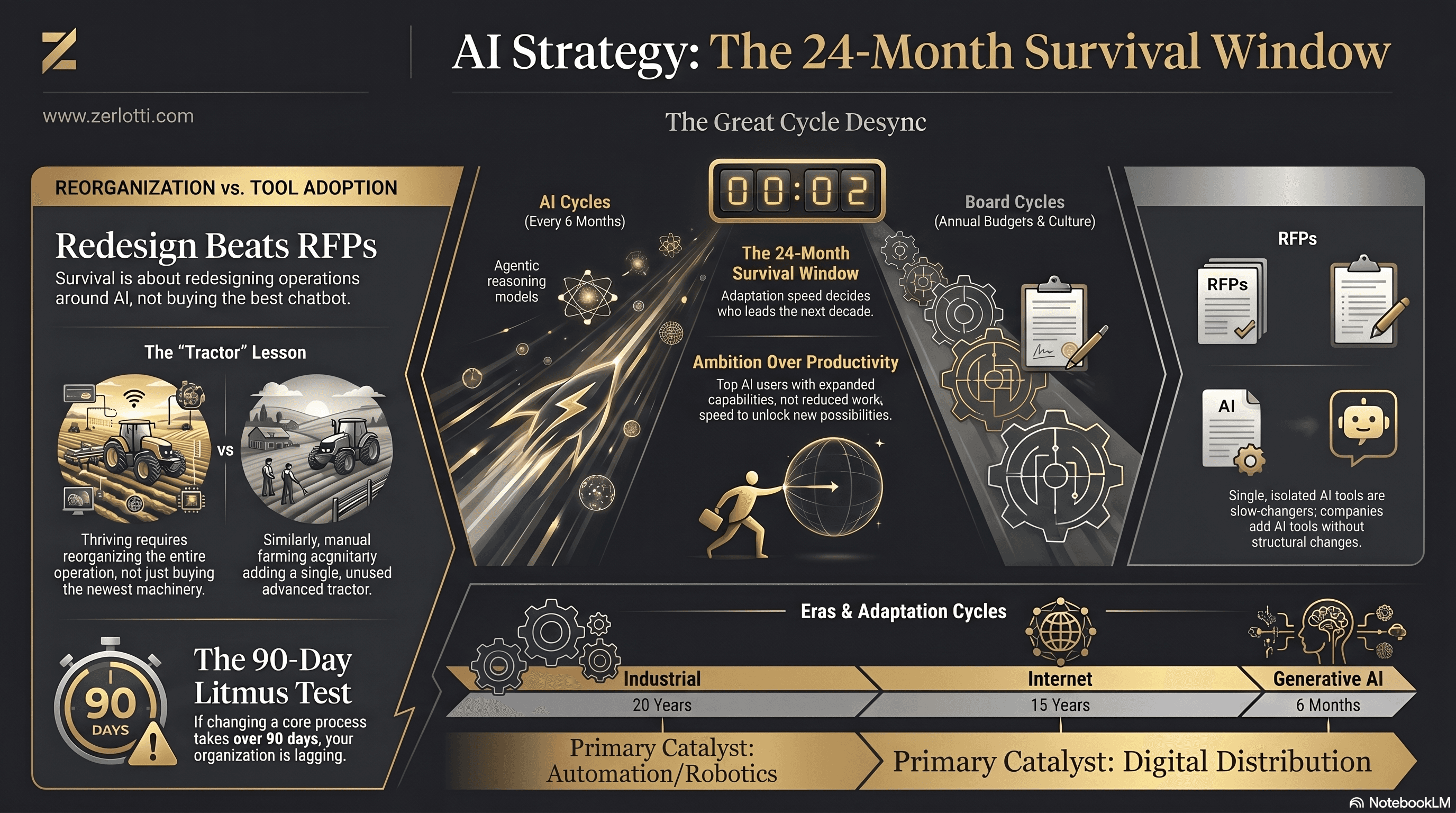
Last week, reading the AI reports that hit my inbox every day, I stopped at a sentence that looked harmless. An analyst described the new wave like this: AI is leaving the text box. It is no longer a chatbot you open. It is a system that clicks, talks, reads the screen, executes the task, comes back with the result. Codex on the phone, Gemini inside Android, Claude automating real legal work, UiPath agents, the first AI that interrupts you before you ask.
I closed the report and thought about a conversation I had a month ago with the CEO of a mid-to-large Brazilian company who told me, with the calmest voice in the world: "we are evaluating which AI tool to adopt and we will deploy company-wide next year". Evaluating? For next year?
That sentence is far more common than we think. And that sentence is what I want to talk about.
The wrong question costs a lot
The conversation about AI is still a conversation about technology. Which model is better. Which vendor to pick. Which license to buy. How much a token costs. That matters, but it is the easy part. The part you solve with an RFP, three months of proof of concept, and a purchasing decision.
The hard part is somewhere else. And history has already shown, several times, what separates who survives from who disappears in a transformation like this.
Think about agricultural mechanization in the twentieth century. The tractor existed. Information existed. Access to credit existed. And even so, half the farms disappeared in two decades. It was not because the tractor arrived late. It was because the structure of the farm, the management model, the size of the operation, the relationship with labor, could not reorganize at the speed the technology demanded. Those who bought the tractor and kept the farm the same size went broke. Those who bought the tractor and rebuilt the whole operation around it grew ten times.
Industrial automation in the eighties. Same story. The factories that survived were not the ones with the most expensive robots. They were the ones that managed to redesign the line, the shift, the hierarchy, the quality system, around what the robots did differently.
The internet in the nineties and two thousands. You remember bookstores, video rental, travel agencies, record shops. They all got access to the internet at the same time. They all had a board, a vendor, a consultant. What separated Blockbuster from Netflix was not the technology. It was the speed at which an entire organization managed to reorganize itself around a new distribution logic.
Every comparable transition was decided by the speed of organizational adaptation, not by the speed of the technology itself. The technology reaches everyone more or less at the same time. The reorganization does not.
Why the window is shorter this time
The difference between AI and earlier transformations is the cycle time. Agricultural mechanization took thirty years to redesign the field. Industrial automation took twenty. The internet took fifteen. AI is making visible moves every six months.
Look at what happened in just the last few weeks. OpenAI closed the reasoning gap in voice agents. Google released Gemini Computer Use, which operates the browser the way a person would. Codex went to the phone. Claude started automating real legal work, not demos. Gemini became a layer inside Android, not an app on Android. A model appeared that trains with a thousand times less compute. Anthropic signed a compute partnership with SpaceX, because conventional cloud no longer keeps up.
Each of these moves, on its own, looks small. Put together, they redesign the way work is executed inside a company. And the gap between one move and the next is weeks, not years.
When the cycle of the technology runs faster than the cycle of board decision-making, the company enters a structural mismatch. The technology changes in months. The budget gets approved once a year. The reorganization has to go through the people committee, legal, audit, the risk function. Culture changes at the speed of the most conservative director's patience.
That mismatch is where people will lose jobs. And here I want to be blunt, because I think this is being said the wrong way out there.
Why people will actually lose jobs
It is not because AI is going to replace workers. That is the lazy read.
It is because the company the worker is in will not manage to reorganize fast enough. The technology that creates the possibility of doing the same work with half the team reaches company A and company B on the same day. Company A reorganizes the operation in six months, redeploys people into higher-leverage roles, gains margin, grows, hires more. Company B spends those same six months debating which tool to buy, then nine more months trying to integrate, then another year discovering that the integration does not work because the underlying process was never redesigned. By month 24, company B has lost market share, lost margin, and lays off. It does not lay off because AI replaced the people. It lays off because company A, more agile, ate its operation.
Of course there will be accelerated layoffs during this transition, many of them frontloaded by companies that decide to cut before redesigning, but that is not the main event. The big unemployment in this transition comes from the slowness of the organization that employs the human being. The company that does not adapt is the one that lays off. The machine fires no one. Inertia does.
That changes the board conversation entirely. It is no longer about whether AI will take jobs. It is about whether your company will be on side A or side B over the next twenty-four months.
What a few will build, and most will not see coming
The window is short because the advantage compounds. Whoever reorganizes first finds that leaner processes generate better data, better data trains better agents, better agents free up senior people to solve harder problems, and harder problems solved turn into product. In two years, what was a difference in speed becomes a difference in capability. And a difference in capability can no longer be bought with an RFP.
Most companies will reach 2028 still debating which tool to adopt. A few will reach 2028 with an organization redesigned around a logic competitors still do not understand. Those will run the whole decade ahead.
And what separates the two is not budget, not size, not sector, not even technical talent. It is the speed at which the board stops treating this as an IT decision and starts treating it as a redesign of the company.
The question I leave with you, if you run a company today, is simple and uncomfortable. How long does your organization take, today, to actually change a process. Not to announce the change. To change it.
If the answer is more than ninety days, you already know which side of the window you are on.