
When someone tells me AI will destroy jobs, I usually answer with a simple question: which jobs?
The sentence sounds strong. It sounds like the person is looking at the future without sentimentality. But often it hides confusion. It treats the labor market as if it were a spreadsheet with two columns: jobs that continue and jobs that disappear.
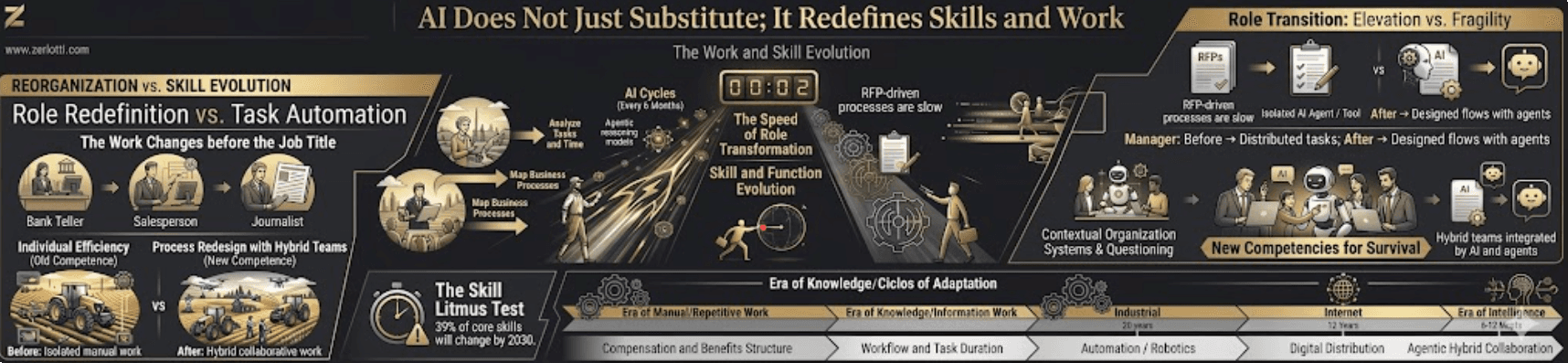
Reality is usually more uncomfortable. Work changes before the job title changes.
That is how almost every major technological change has worked. Bank tellers did not disappear on the first day of online banking. Salespeople did not disappear on the first day of e-commerce. Journalists did not disappear on the first day of Google. But their work changed. Some tasks lost value. Others became more important. New roles appeared with strange names at first, then became normal.
With AI, this movement is faster. That makes headline-only thinking dangerous.
A positive number is not comfort
The World Economic Forum Future of Jobs 2025 report estimates that 170 million new jobs may be created by 2030, while 92 million may be displaced. The projected net balance is positive, around 78 million jobs. That number should not make anyone relaxed. It should make leaders pay closer attention.
Because the point is not only how many jobs will exist. The point is what kind of work those jobs will require.
The same report estimates that 39% of core skills required in the market will change by 2030. Almost four out of ten. We are not talking about learning a new tool over a weekend. We are talking about a change in what it means to be competent inside a company.
The public conversation is trapped in a poor image: robots replacing people. That image sells fear, but it does not help a CEO decide. In many companies, the most relevant change will not be a mass layoff caused by one tool. It will be a change in the value of each kind of work.
People who only execute repeatable tasks lose space. People who can direct systems, judge answers, organize context, ask better questions, review decisions and connect AI to the real problem of the company become more important.
Notice the difference. A person does not need to become a programmer to remain relevant. But that person does need to understand how to work with an intelligence that already writes, summarizes, compares, analyzes, simulates, recommends and, more and more, executes parts of the process.
Roles are changing from the inside
The manager who used to distribute tasks now has to design flows where people and agents work together. The analyst who used to prepare reports now has to question assumptions, validate data, interpret exceptions and explain consequences. The customer service professional stops answering everything manually and starts supervising cases that need human judgment.
Work does not disappear all at once. It rises in level for the people who can keep up. And it becomes more fragile for the people who remain attached to the part the machine has learned to do.
Microsoft made a similar point in its Work Trend Index 2025. The study, based on 31,000 workers across 31 countries, describes companies organized around hybrid teams, with humans and agents working together. According to the report, 81% of leaders expect agents to be integrated moderately or extensively into the company AI strategy over the next 12 to 18 months. And 78% are already considering hiring specific AI-related roles.
The names still sound new: AI trainers, agent specialists, AI return analysts, AI strategists, security and data specialists. Some titles will change. Some will disappear. Others will become a normal part of existing functions.
But the signal is clear. The market is not only asking who can be replaced. It is asking who can operate the new combination of person, process and artificial intelligence.
The shortage will be capability, not people
If you run a medium or large company, the question about jobs should not begin with cost cutting. It should begin with capability. What kind of capability will your company need in two years that it does not know how to build today?
Most companies still treat AI as an individual tool. They buy access, release it to a few teams, run basic training and track a few use cases. That can create efficiency, of course. But individual efficiency does not solve the talent problem that is coming.
A marketing professional who uses AI to write faster improves a task. A marketing professional who knows how to build a process where AI researches, compares arguments, preserves brand voice and learns from results changes the nature of the work. The same applies to finance, operations, customer service, legal work and sales.
That is why a company may hire many people over the next few years and still feel short of talent. The shortage is not people in a generic sense. The shortage is people capable of working in a company where part of the intelligence is no longer only in people heads, but also in the systems they direct.
Anthropic published a study on AI labor market impacts that helps bring some calm to this conversation. So far, the report did not find a systematic increase in unemployment in the occupations most exposed to AI. At the same time, it found signals that hiring of younger workers in exposed occupations may be slowing.
That detail matters. The first pain may not appear as a simple wave of unemployment. It may appear as a narrower entry door. Junior jobs that used to exist for research, first drafts, information organization and basic execution may be among the first to change. But those jobs were also the school where many people learned judgment.
If a company automates the initial work without redesigning how it trains new professionals, it gains efficiency today and creates a problem tomorrow.
AI does not only change how many people you need. It changes how people learn inside the company. If the junior employee no longer learns by doing the old tasks, that person needs another path. If the manager starts coordinating agents, that manager needs a capability nobody taught. If leadership wants speed, it also needs criteria, review and responsibility.
Otherwise, the company trades manual work for invisible dependence.
That is the talent that will be scarce: leaders who know how to delegate to agents, managers who know how to draw limits, business professionals who know how to talk to technology without becoming dependent on it, specialists who know how to turn experience into criteria for systems.
So the executive decision is not to wait for the market to solve the problem. The market will become expensive when the shortage becomes obvious. The decision is to start looking now at the company main flows and ask which roles are changing from the inside. Where does one task disappear? Where does another become more important? Where does a junior employee stop learning? Where does a manager need to coordinate agents? Where does human judgment become more valuable because execution became cheaper?
This is less comfortable than buying software. But it is more strategic.
The company that understands this change early does not simply react to new job openings. It starts developing the right people before the market gives the roles official names. It redesigns work before pressure arrives. It preserves judgment while increasing speed. It understands that AI does not eliminate the need for good people. It changes what good people means.
So the question is not whether there will be work.
There will be a lot of work.
The question is who will be ready to do the work that will exist.
Sources
- World Economic Forum, Future of Jobs Report 2025.
- Microsoft, Work Trend Index 2025.
- Anthropic, Labor market impacts of AI, 2026.