
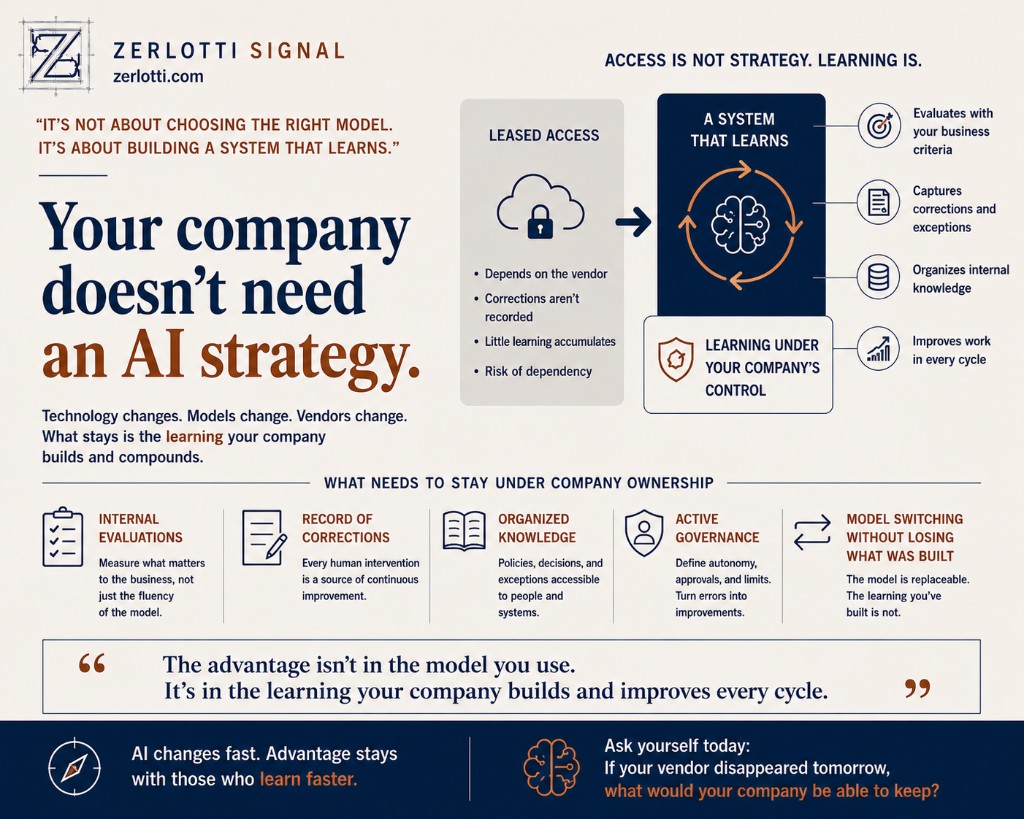
A vendor outage interrupts the service. A policy change limits how data can be used. A model price increase changes the economics of the project. In each case, the company discovers how much of what it called strategy was actually controlled by a third party.
Many executives still treat AI strategy as a combination of vendor selection, model selection, and pilot development. These decisions are necessary, but they address only how the company gains access to technology already available in the market.
A company builds a durable advantage when it can observe the work, measure the outcome, record the corrections people make, and use that information to improve the next run. When the organization controls this cycle, it can change models and vendors without losing what it has learned.
This is why AI needs to be part of the business strategy rather than treated as a separate strategy. The goal is to use the technology as a continuous way to learn and improve the work.
Choosing a vendor only solves access
Buying access to a model provides immediate capability. A team can summarize documents, answer questions, produce analyses, or automate steps in a process without building the technology from scratch. This reduces the time and cost required to get started.
The problem begins when the implementation ends there. The company sends data, receives answers, and measures little of what happened during the work. Corrections made by employees remain scattered across conversations, spreadsheets, or the memory of the person who reviewed the output. The vendor processes more interactions, while the organization retains little knowledge it can reuse.
Consider a system that helps a customer service team prepare responses. When an employee corrects a fact, adjusts the tone, or identifies a contractual exception, that intervention contains knowledge about the business. If the correction disappears after the response is sent, the system may repeat the same mistake. The person learns, but the process does not.
This helps explain why so many pilots look promising but deliver little after the initial demonstration. They prove that the model can perform a task. They do not prove that the company can improve that task consistently, measure its quality, or replace the technology without starting over.
Access to AI capabilities is becoming easier. Whether that access produces knowledge the company can retain remains a management decision.
The learning needs to stay inside the company
A system that learns begins with concrete elements. The company defines what it considers a good answer, connects that definition to a business outcome, and tests the system against situations that occur in the actual work.
These internal tests are often called evaluations, or evals. Instead of checking only whether the model produced an answer, the company examines whether the answer followed a rule, reduced rework, avoided a risk, or helped the customer solve the problem. The standard needs to reflect the business, not just the fluency of the model's response.
The second element is recording what happened during the work. What information did the system consult? Where did it make a mistake? What correction did the person make? Which exception required approval? These records help the company adjust instructions, update its knowledge base, review the process, and, when appropriate, train specific components.
The third element is making knowledge easy to find. Policies, previous decisions, quality standards, and known exceptions need to be organized so both people and systems can find them. A folder full of outdated documents does not meet that need.
With these components in place, each run can produce useful information for the next one. The process improves because the company knows what happened, can compare outcomes, and incorporates the corrections. This is how human judgment works together with the processing capability of models.
When a company does not record or apply what it learns, it is renting a capability. When it keeps evaluations, corrections, and knowledge under its control, that learning remains even when the technology changes.
Governance also produces learning
Governance often enters AI projects late, usually as a list of approvals required before a purchase. That approach reduces the subject to documents, permissions, and formal responsibility.
In a system designed to learn, governance is part of the work. It defines when an agent can act on its own, when it must ask for confirmation, which sources it may consult, and which decisions require human review. It also determines how incidents are recorded and how errors lead to changes in the process.
Imagine an agent authorized to grant a specific benefit to a customer. A governance rule can set value limits, require approval for exceptional cases, and record the reasons behind each decision. These controls reduce risk while showing where the agent struggles and which exceptions occur frequently.
Each human approval creates a useful record. If people repeatedly correct the same category of decision, the problem may be in the instructions, the available data, or the process rule itself. Governance helps the company identify that pattern.
This design requires people who understand the work. The technology team can build the recording and evaluation mechanisms, but business teams need to define quality, acceptable risk, and the expected outcome. Without that contribution, the company automates an incomplete understanding of the process.
Changing models should be routine
Dependence on a vendor becomes dangerous when the model also holds the quality criteria, correction history, and method used to perform the work. In that situation, changing the technology means losing part of what the organization has learned.
A better-prepared company keeps its internal evaluations, relevant records, knowledge base, approval rules, and business metrics under its own control. The model remains important, but it performs a function that can be replaced within a larger system.
This changes the executive conversation. Instead of focusing on which model ranked first in the quarter's comparison, leadership begins to ask how much each use helps the company learn. It also examines whether that learning can be audited, whether teams can maintain it, and whether another vendor could take over the work without destroying what has already been built.
If the current vendor disappeared tomorrow, what could the company preserve? The answer shows whether the company is accumulating its own knowledge or merely consuming a capability controlled by a third party.