
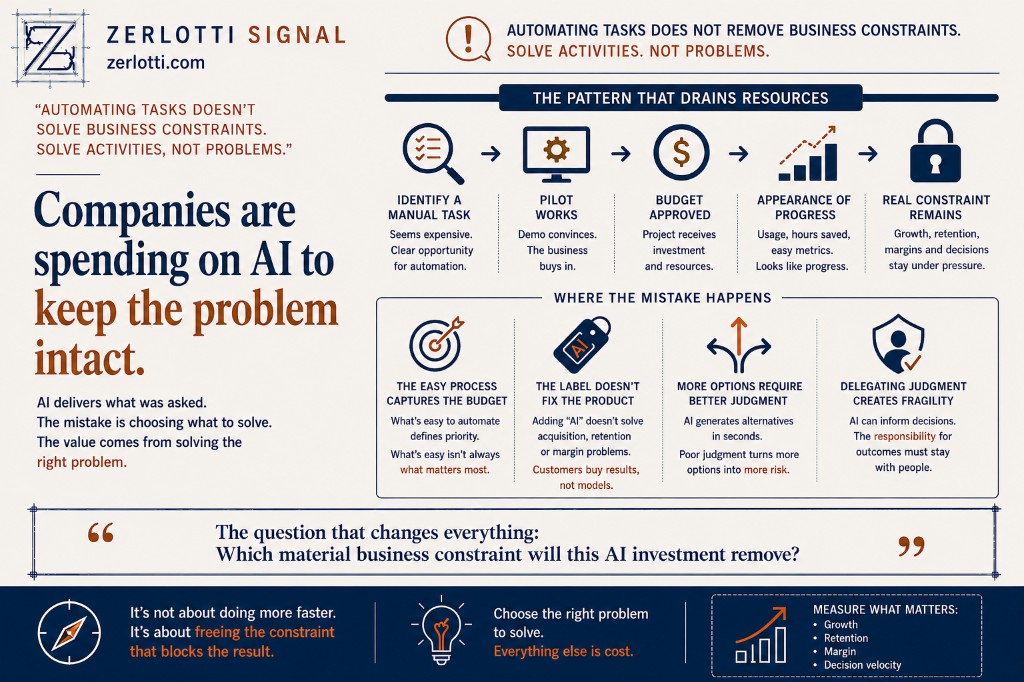
I keep seeing the same pattern in AI investment decisions. A team identifies a manual task, calculates how much time it consumes, and proposes automating it. The pilot works, the demonstration is convincing, and the project receives funding.
Even so, the company may still have too few customers, low retention, pressured margins, or slow decisions. The task was automated, but the obstacle limiting the business remained intact.
Companies are committing capital, attention, and leadership time to AI projects that improve isolated activities without addressing the causes of weak growth, customer loss, or business fragility. The technology delivers what it was asked to deliver. The problem began when the company chose what to solve.
The appearance of progress makes this mistake difficult to see. An automation running in production can be measured and presented. Meanwhile, more important problems remain unanswered because they require changes to the product, the customer relationship, or the way the company makes decisions.
The Easy Process Captures the Budget
When a new technology becomes available, it is natural to look for tasks it can perform. A manual process consumes hours, appears expensive, and offers a clear case for automation. Because the benefit is easy to explain, the project moves forward quickly.
The mistake begins when ease of automation determines the investment priority. Before choosing the technology, leadership needs to identify what is preventing the company from growing, delivering better results, or protecting its margins.
If the difficulty is customer acquisition, automating an administrative activity may reduce costs without increasing revenue. If customers abandon the product, generating campaigns faster does not improve their experience. If the company takes too long to decide, producing more reports may increase the volume of information without improving the decision.
These automations may be useful. The risk appears when they receive funding and attention as if they had removed the company's main obstacle. Leadership tracks pilots, tool usage, and hours saved but fails to verify whether any relevant business problem has been reduced.
I see the cost as greater than the amount recorded in the budget. The project also occupies capable teams, creates technical dependencies, and teaches the organization to prioritize initiatives that are easy to demonstrate. When the business result does not appear, the technology is blamed for a decision that began with choosing the wrong problem.
The Label Does Not Fix the Product
The same distortion appears when a company adds AI to a product without improving the outcome the customer is buying. The technology enters the name, description, and sales pitch, but the customer still evaluates whether the product helps them respond faster, make fewer mistakes, sell more, or complete a task with greater confidence.
An insurer can analyze documents faster. A retailer can forecast demand more accurately. A manufacturer can shorten an inspection. AI creates value when it improves an important outcome in a way the customer can perceive.
When the product offers only a thin layer over models already available in the market, its differentiation may disappear as soon as the same capability becomes standard in a larger platform. The label remains, but the company still has not solved its acquisition, retention, or margin problems.
I would evaluate this investment based on customer access, data generated through real work, integration with critical processes, and responsibility for the outcome. These elements help sustain the business even when the technical capability becomes common.
More Options Require Better Judgment
AI also increases the number of alternatives a company can produce. A team can generate several campaigns, product versions, or analyses in a fraction of the time previously required.
This lowers the cost of producing options, but it makes good judgment more important. If the company already struggled to set priorities, more alternatives may expand the problem instead of solving it.
The consequence becomes more serious when the system participates in decisions about credit, pricing, hiring, or shutting down an operation. The analysis may be produced in seconds, but the financial, legal, and reputational exposure remains with the company.
Delegating that judgment entirely creates fragility. The recommendation may change depending on the question or the information provided. At the same time, professionals who stop exercising critical analysis lose the ability to recognize when the system is wrong.
I would use AI to test hypotheses, compare options, and reveal blind spots. Defining the problem, setting the decision criteria, and approving consequential actions need to remain with the people who will answer for the consequences.
The Board Needs to Measure Constraints
Pressure for quick results favors projects that are easy to automate, weakly differentiated products, and decisions transferred to systems too early. Each initiative may appear efficient when viewed in isolation. Together, they consume resources without necessarily making the company stronger.
For that reason, counting projects, users, or automated hours says little about the quality of the investment. Leadership needs to connect each initiative to a material business obstacle and track whether that obstacle was actually reduced.
The question I would ask in a boardroom is direct: which relevant obstacle to growth, retention, margins, or decision-making will this AI investment remove?