
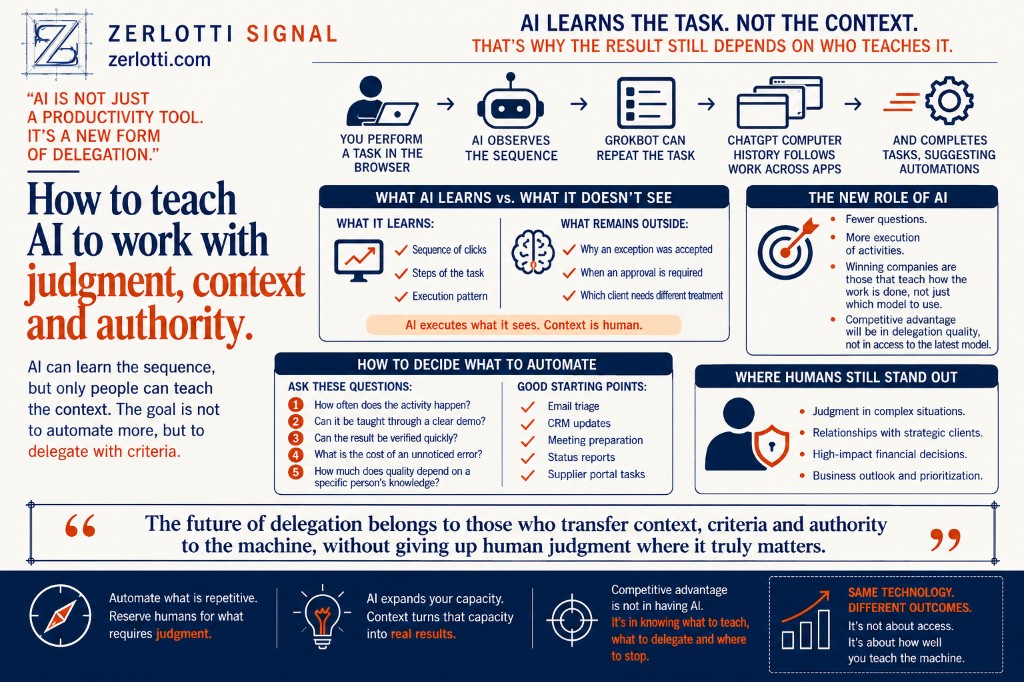
A plumbing services company implemented automated crew dispatch in 24 hours, according to the account presented. It used GrokBot, with no engineers involved in the implementation.
The timeline gets attention, but I read this case from another angle. GrokBot watches a person perform a task on a computer and then repeats the process. The company does not need to program every step. It teaches the system by showing how the work gets done.
ChatGPT's Computer History points in the same direction. The tool observes activity across different applications and builds context over time. This allows AI to learn routines, preferences, and recurring decisions instead of relying only on an isolated instruction.
This changes an important source of competitive advantage. Access to advanced models will continue to expand. The difference between companies will come from their ability to transfer to AI what currently remains in people's heads: the context behind each task, the criteria used to make decisions, the exceptions that matter, and the limits on action.
AI learns work by watching
Until recently, automating a process required someone to describe every step in advance. The company had to map the workflow, configure integrations, handle exceptions, and turn people's experience into rules a system could follow.
Now, part of that teaching can happen through observation. A person sorts emails, prepares for a meeting, updates the CRM, or accesses a supplier portal. AI follows the sequence, identifies the data being used, and learns the path from one application to another.
This lowers the cost of teaching a task to a machine. A routine that would never have justified a technology project can become a candidate for automation because someone can demonstrate it in a ten-minute screen recording.
I see a direct consequence for leadership. Knowing which tools are available is no longer enough. The company needs to understand its own work much more precisely. If no one can explain how a task is performed, which exceptions matter, and who is accountable for the outcome, AI will not have a reliable reference either.
The current limits of these models appear at exactly this point. They can already use applications, take actions, and repeat sequences. What they still lack is specific knowledge of how each person or company works. That context does not come built into the model. It has to be transferred.
Work must be separated by risk
The decision does not begin with choosing a tool. I would start with recurring processes that consume time every week: sorting emails, preparing for meetings, producing reports, updating the CRM, conducting research, scheduling, and completing tasks in supplier portals.
Each process should be tested against five practical questions:
- How often does it happen, and how much time does it consume?
- Can someone teach it with a ten-minute screen recording?
- Can the result be checked much faster than the task can be performed?
- What is the impact of an error that no one notices?
- How much does quality depend on one person's judgment, taste, or relationships?
Frequent tasks that are easy to teach, quick to check, and inexpensive to get wrong can be assigned to AI. Updating a record from defined data or preparing a recurring report are good examples when objective criteria exist for verifying the result.
At the other end are decisions where an error is costly, affects sensitive relationships, or depends heavily on one person's judgment. Choosing someone for a leadership role, conducting a delicate negotiation, or approving a response with legal consequences still requires human accountability.
Most knowledge work falls between these two points. AI can prepare the analysis, gather documents, draft a response, or execute routine steps. A person reviews the material and makes the decision that carries meaningful consequences.
This separation prevents two mistakes. The first is keeping people occupied with repetitive tasks that a machine can already handle. The second is giving AI too much authority before the company has clear criteria for checking the result and stopping an inappropriate action.
Context requires authority and control
The more AI learns through observation, the more useful it becomes. It begins to recognize how an executive prepares for meetings, which information a team reviews before approving a supplier, and which exceptions require attention. Over time, it stops being a tool used occasionally and starts participating continuously in the work.
I would not treat this development as simple task automation. When an agent gains access to emails, systems, files, and histories, the company transfers part of its accumulated knowledge about how work gets done. When that agent can also send messages, change records, or schedule activities, it receives authority to act on behalf of the organization.
That authority needs clear limits. Leadership must define which systems the agent can access, which actions it can take on its own, which ones require approval, and how each decision will be recorded. It must also determine who is accountable when the agent uses correct information in the wrong context.
Privacy is part of the same decision. An agent that observes employees creates a new record of the company's activities. That record can include habits, decisions, information consulted, and paths taken across systems. It therefore needs to be protected with the same discipline applied to the organization's most sensitive data.
In practice, teaching the task is only part of the work. The company must also teach the agent when to stop, when to ask for help, which information it cannot combine, and which decisions it must never make without human approval.
The question I would ask leadership is simple: if AI learned today by observing the team's work, which recurring process would it be authorized to execute tomorrow? The answer reveals whether the company merely knows its tools or understands how its own work gets done.