
A CEO proudly showed me the slide with the board's decision. They had picked the AI vendor, set up a committee, approved the budget for the first pilots. It was competent work, the kind that reassures any board.
I asked what would happen if that vendor went down for a day. The silence answered. I went home thinking the company had decided everything except the one thing that matters.
Most companies are building the wrong strategy
The confusion starts early. Treating AI as a vendor decision feels responsible. You choose between OpenAI, Anthropic, Microsoft, Google. You set up a committee. You launch a pilot. You announce a strategy. All of it conveys a sense of control.
As it happens, that structure is fragile. A company that organizes its operating logic around one model, one vendor, one single path of access, is renting a capability it does not control. The recent Fable outage made that plain. When access goes down, the entire operation built on top of it goes down with it.
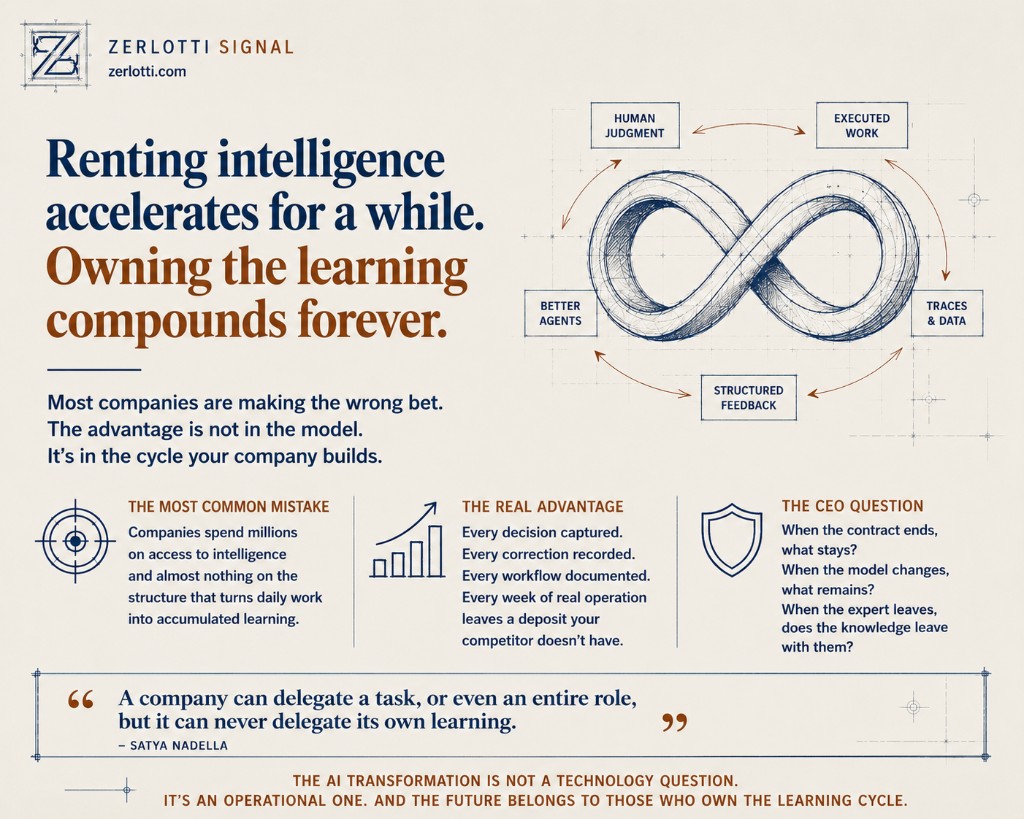
Satya Nadella put the question more sharply than most of the commentary on AI today. A company can delegate a task, or even an entire role, but it can never delegate its own learning. The line sounds simple. It reorganizes the whole question.
The learning loop is the asset, not the model
The structural shift is not in the model. It is in the loop that forms around it. Human judgment enters the workflows. The workflows leave traces. The traces become feedback. The feedback improves the agents. The agents return better work to the humans. The humans correct, refine, teach the system again. And the loop starts over, a little smarter on each turn.
That loop is institutional capital. Private evaluations. Internal knowledge bases. Reinforcement learning environments. Model routing. Process memory. Expert corrections captured in usable form. None of it depends on believing that one model wins forever. The model matters. The proprietary system built around it matters more.
This is where many companies will get stuck. They spend millions on access to intelligence and almost nothing on the structure that turns daily work into accumulable learning. The result is cruel in its simplicity. The company's best judgment stays trapped in meetings, inboxes, documents and the individual memory of a few people. Readable. Searchable. Occasionally reusable. Almost never executable.
The advantage moved from generic delivery to proprietary learning
For anyone running a company, the implication is uncomfortable. AI transformation has become an operational question, not a technology question. The advantage goes to the organization that captures its own decisions, corrections, workflows and expertise in a form that improves every week.
The drop in Accenture's stock is a signal of this pressure. Generic transformation delivery is losing value. Deep functional expertise, real implementation and proprietary learning systems are gaining value. The market has started to price the difference between those who rent and those who accumulate.
And that difference is one of orders of magnitude, not margin. Companies that rent intelligence will move faster for a while. They will look ahead. They will impress in the short term. But whoever owns the learning loop compounds. Each week of real operation leaves a deposit. Each expert correction becomes accumulated operational instinct inside the system, not inside the head of a person who could leave tomorrow.
The question the board has not asked yet
If you run a company, the right question is not which vendor to choose. It is which part of your AI learning loop you actually own. When the contract expires, what stays? When the model changes, what remains? When the expert resigns, does their knowledge walk out the door or was it recorded in executable form?
Most boards approved the access budget and forgot to build the structure that captures. They inverted the priority. They spent on what is rented and saved on what is owned.
The CEO with the slide had decided who to connect to. He had not decided what to retain. Renting intelligence accelerates for a while. Owning the learning compounds forever. The difference does not show up in the first quarter. It shows up when it is already too late to build.