
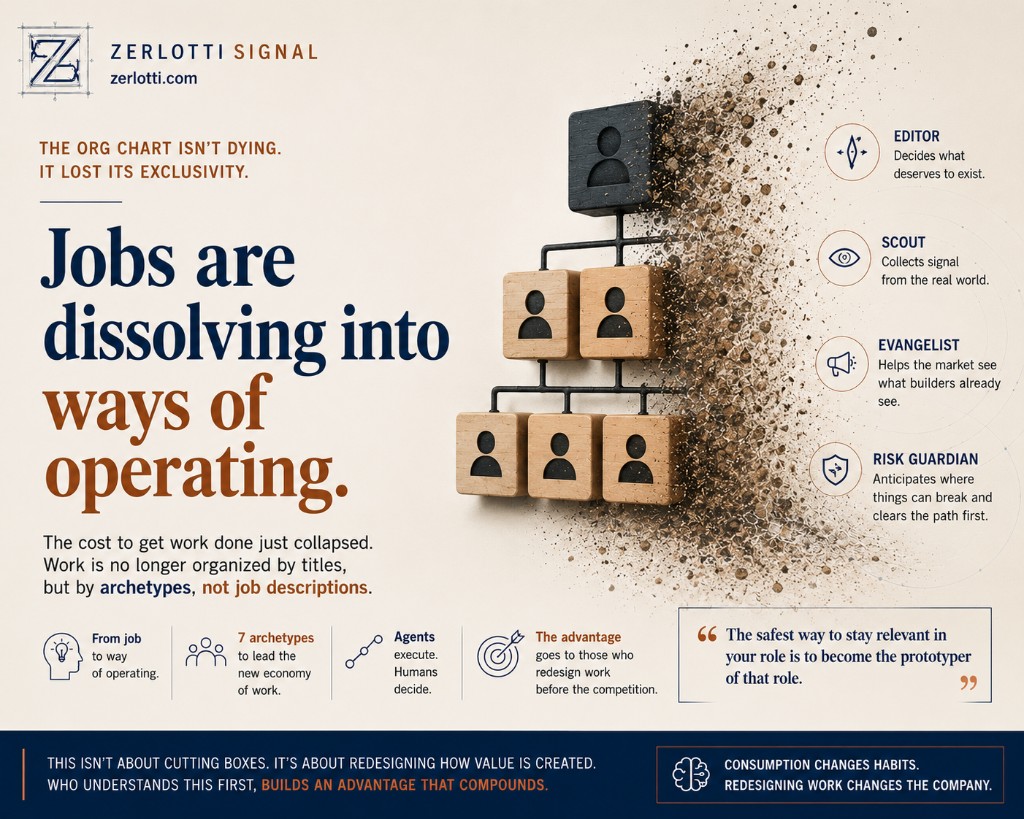
Boris Cherny, creator of Claude Code, mapped his own team and the result did not fit the org chart. He found five archetypes: the prototyper, the builder, the sweeper, the cultivator, the maintainer. None of them is tied to a formal role, and his caveat matters more than the list: a healthy team needs the right mix of these profiles depending on the product's stage of life.
Most executives read the AI transition through the wrong question. They ask which jobs will be automated, as if the org chart could survive with fewer boxes. It cannot. The boxes themselves are dissolving, and what takes their place looks less like a title and more like a predominant way of operating.
That is why job descriptions age so fast. Work stops being something a person executes and becomes something a person supervises: agents produce, prototype, test, while the human decides what deserves to exist. When that happens, the relevant unit of organization stops being the role and becomes the predominant way each person creates value inside the work.
The org chart was designed for a cost of doing that no longer exists
For decades, the job title was the company's basic unit. Companies hired by title, promoted by title, measured by title. The design made sense because doing was expensive: every deliverable required human hours, and human hours had to be allocated, supervised, budgeted. The org chart was the map of that cost. It was legible. Hirable. Promotable. Auditable.
Then the marginal cost of doing collapsed. A prototype that used to take a team a full quarter comes out in an afternoon with agents. When producing gets cheap by that order of magnitude, scarcity moves: execution capacity is abundant, and what is missing are people who know what is worth building, who should see the result, and where each initiative can break. The operating logic inverts. And roles designed to manage scarcity of execution stop describing the real work.
The hardest archetypes look outside the product
Cherny's five archetypes look inward, at the artifact being built. The harder set looks outward, at the people and the signal around the work. The editor, who decides which cheap prototypes deserve to exist. The scout, who collects signal from the real world. The evangelist, who makes the market see the world the way the builders see it. And the risk keeper, who anticipates the derailment three steps ahead.
Read that last one again. The risk keeper stops being a gatekeeper and becomes an accelerator. Instead of blocking initiatives at the door, they anticipate where each one can break and clear the path in advance. That single inversion separates the organizations that keep pace from the ones that lurch forward. Not by accident, it is the archetype that appears least in transformation plans and the one most missed when the pilot hits real operations.
When doing gets cheap, every department gains a prototyper
The practical consequence goes far beyond the product team. A back-office person builds a small tool to handle one specific exception instead of opening a ticket and waiting a quarter. No queue. No project. No committee. That is prototyping, and it is product thinking reaching finance, HR, operations, departments that never touched a product in their lives.
The individual consequence is uncomfortable and clarifying at the same time. The safest way to stay relevant inside a role is to become the prototyper of that role. Replacing the company's software is the smaller part. The bigger part is pushing the organization to see opportunities it did not know it had, and placing yourself at the center of the change that redraws your own job.
If you run a company, this calls for a change of question. Instead of debating which boxes on the org chart disappear, the useful exercise is mapping which ways of operating already exist in-house without a name: who already prototypes on their own, who already edits, who already collects signal, who already anticipates risk without being asked. The archetypes do not arrive on a Monday of restructuring. They arrive as people discover which one they already are. The company that sees this first assembles the right mix before its competitor does, with the same people already on payroll.
Which archetype are you when no one assigns you a title? The title said what a person was hired for. The way they operate decides where they create the most value.