
A company buys computing capacity, selects vendors, and puts several projects into testing. Teams experiment with models and refine prompts. Months later, the CFO asks how much value those projects created, and no one can provide an objective answer.
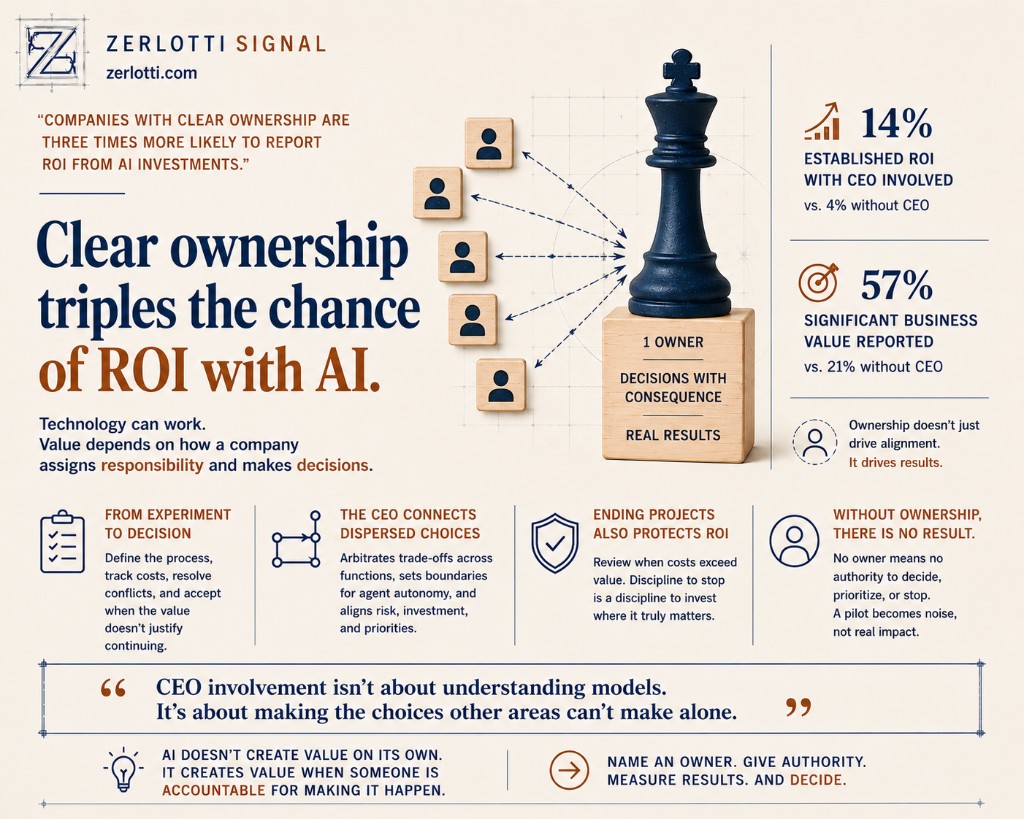
The most common reaction is to look for a problem with the technology. Perhaps the selected model is not good enough. Perhaps the company lacks data, integration, or training. All of these can affect performance, but KPMG's Quarterly Pulse Survey points to a more basic difference: organizations with clearly defined accountability are three times more likely to report a return on AI investment.
The difference also appears when the CEO takes direct responsibility. According to the survey, the share of organizations reporting established ROI rises from 4% to 14%. Reports of significant business value increase from 21% to 57%.
These figures do not prove that CEO involvement alone produces the return. They indicate that AI delivers more value when someone has the authority to choose priorities, stop projects, and resolve conflicts across functions. The technology may work, but its value depends on how the company assigns responsibility and makes decisions.
A pilot must lead to a decision
A pilot can work technically and still fail to create value. An assistant can draft high-quality documents, an agent can handle requests, and a model can analyze thousands of records. None of this shows whether the gain justifies the cost or whether the underlying process needs to change.
Moving from testing into operations requires decisions with consequences. Who chooses the process that will change? Who is accountable for reducing costs or increasing revenue? Who authorizes access to systems? Who stops the project when model usage costs more than the expected benefit?
Without clear answers, accountability becomes scattered across the organization. The technology team approves the environment, the business function suggests use cases, security sets limits, finance questions the budget, and the vendor presents new possibilities. Everyone participates, but no one owns the overall result.
In this situation, AI appears to be a technical problem even though the real difficulty is coordination. The project accumulates meetings, exceptions, and dependencies. Because no function has the authority to resolve the conflicts, the pilot remains active without a convincing economic case.
Naming one accountable person changes this behavior. That person must defend the investment, track costs, and accept the possibility of stopping the initiative. The experiment begins to compete for resources like any other company priority.
The CEO connects scattered decisions
CEO involvement does not require supervising prompts, comparing models, or approving every application. The CEO's role is to connect decisions that no single function can make on its own.
An AI agent can cross customer service, sales, operations, legal, and technology during a single task. It retrieves data, activates systems, produces a response, and, in some cases, executes an action. Each step may have a different owner, but the overall outcome affects both the customer and the financial statements.
Leadership needs to define how much autonomy the agent has, when a person must approve an action, and who is accountable for a failure. It must also decide which processes deserve investment and which should remain as they are.
These choices involve legitimate conflicts. Sales may prioritize speed while legal asks for more controls. Technology may prefer a shared platform while a business unit wants to buy a specific solution. Finance may demand a quick return even when the use case depends on deeper process changes.
The CEO can settle these conflicts because the role brings budget, risk, customers, and strategy into the same decision. Direct CEO accountability gives the company a clear decision-maker when an issue crosses multiple functions. This helps explain why CEO involvement is associated with better results. The gain comes from completing choices that other functions cannot settle on their own.
Stopping projects also protects returns
According to KPMG's material, half of organizations reorganize their projects when costs exceed expected value. This review does not necessarily indicate failure. It may show that the company has learned enough to stop funding a hypothesis that did not hold.
This becomes more important when models charge based on usage. A project may appear economical during the pilot and become expensive when thousands of customers, employees, or transactions begin using it. Every query, action, or completed step adds cost.
The company needs to monitor this relationship during operations. In some cases, a less expensive model will be sufficient. In others, the company will need to reduce the number of model calls. There will also be situations in which the best decision is to stop the project and move the budget to an application with a clearer impact.
Without a named owner, this correction takes longer. The team that created the pilot tends to defend it. The vendor highlights future improvements. The function using the tool may like the experience without being able to demonstrate a return. While the discussion continues, the costs remain.
A mature company does not measure its ability to use AI by the number of pilots it keeps running. It looks at how many projects reached operations with verifiable results, how many required correction, and how many were stopped before consuming more resources. For that to happen, someone must have the authority to recognize that the hypothesis did not work.
Accountability must reach the result
Many companies already have AI committees, usage policies, and teams responsible for platforms. These structures matter, but they can oversee the technology without being accountable for the economic effect of each initiative.
Leadership can test the difference with a simple question: if the board asks about the return from AI next quarter, who will answer for the decisions that produced it? The answer cannot simply be "the committee," "technology," or "the business functions." Groups can provide guidance and review, but the result needs an identifiable owner.
In practice, every initiative needs to be tied to a business measure, a budget, and the authority to make decisions. The person accountable for the project must be able to increase, reduce, or stop the investment. That person must also explain which process changes are necessary for the technology to create value.
Models will continue to improve, and vendors will continue to offer new capabilities. Those improvements will not solve a lack of accountability inside the company. Before looking for the next use case, leadership needs to decide who can turn a test into a business decision and who has the authority to stop it.