
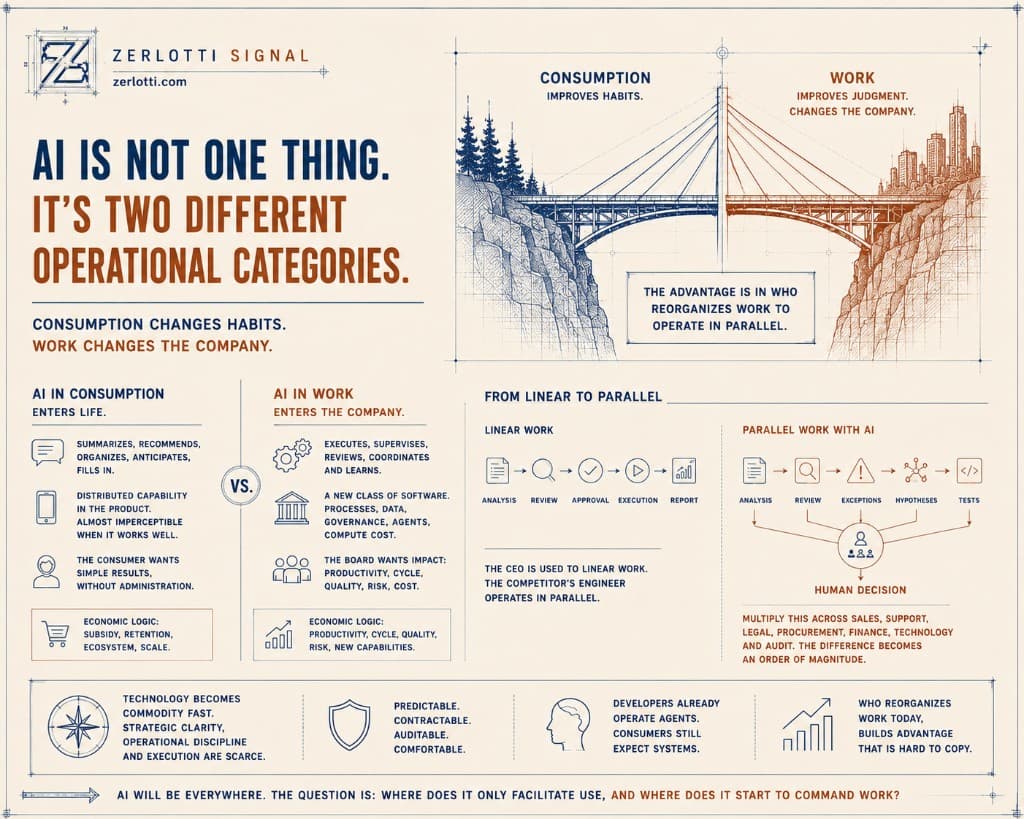
OpenAI announced its "Phase 3" on the same day reports appeared about a confidential IPO filing. The obvious reading came quickly: a message to investors, regulatory preparation, market expansion. The more important reading points to something else. AI has started to split into two different operational categories.
Apple, a few days earlier, showed the contrast. Siri is moving toward summarizing messages, creating events, finding information and executing simple tasks across apps. That matters for consumers. But that AI does not reorganize a company.
The problem is that the word "AI" has become too large to describe what is happening. ChatGPT, Siri, programming agents, corporate copilots, automated researchers, personal assistants and systems that coordinate work still sit inside the same mental bucket. During the chat interface phase, that still worked. The user asked, the system answered, and the difference between personal use and professional use seemed like a difference of degree.
Now the difference has become operational in nature.
On one side, there is consumer AI. It enters the device, the application, the operating system and the everyday flow. It summarizes, recommends, organizes, anticipates, fills in. For Apple, this has always been the most natural logic: AI as distributed capability inside the product, almost imperceptible when it works well. The consumer does not want to manage model, prompt, memory, permission, compute cost and risk. The consumer wants the clearer message, the photo found, the calendar organized, the purchase with less friction.
On the other side, there is work AI. It enters the company as a new class of software. The question stops being whether the user liked the experience. It becomes more concrete: what part of the work can now be executed, supervised, reviewed or coordinated by systems in parallel?
Consumption changes habits, work changes operations
Consumer AI changes behavior. Work AI changes the operational environment.
That distinction looks small because both use similar models underneath. The infrastructure may be the same. The impact is not. One thing is asking an assistant to book a table, summarize a family conversation or suggest a reply to an email. Another is putting agents to review contracts, prepare financial analyses before the meeting, monitor purchasing exceptions, debug code, write tests, compare suppliers and record auditable decisions.
In consumption, the economic logic tolerates subsidy. AI can sell hardware, increase retention, strengthen an ecosystem, reduce friction and justify a subscription. The user perceives value in a diffuse way. Uses more. Stays longer. Switches less. The account closes through scale, margin, recurrence and loyalty.
At work, the logic is harder. AI needs to show up in productivity, decision cycles, quality, risk, marginal cost and new capabilities. A board does not approve an operational reorganization because the assistant became pleasant. It approves when it realizes the competitor ships software in half the time, closes an audit with less rework, answers customers with more consistency or runs analyses that used to require days of preparation.
For that reason, the comparison with iPhone versus Android explains little. Office versus G Suite comes closer, with greater consequence. The AI dispute at work will be a dispute over execution, process, governance, data access, agent coordination and compute cost. It will also be a dispute over trust. Who can execute? Who approves? Who audits? Who answers when the system makes a mistake?
The old model was predictable. Hireable. Auditable. Comfortable.
Developers already live the split
Developers noticed this separation before most companies because their work has a rare characteristic: it can be decomposed, tested and verified quickly. One agent writes tests. Another reviews a pull request. Another looks for regressions. Another explains a legacy codebase. Another proposes a refactor. The human coordinates, decides, corrects, accepts or rejects.
This operational environment is still not perfect. Agents break. Hallucinate. Create plausible and wrong solutions. Require review. But friction with real work happens every day, inside teams that measure time, error, delivery and rework. Calibrated intuition is born there: operating agents daily, noticing where they break, adjusting instructions, writing memory files, discovering what to delegate, learning when to interrupt.
This point is decisive. Companies that observe AI only from the consumer side tend to think maturity is still missing. And it is, for many personal use experiences. The consumer still expects systems that work like dependable systems, not like interesting demonstrations. Wants continuity, memory, context, reliability, privacy and integration without additional work. The promise still arrives before the experience.
In technical teams, however, the curve is different. Even with failures, AI already produces gains because the work accepts decomposition and verification. The code compiles or it does not compile. The test passes or fails. The review finds an error or it does not. There is an objective layer that allows imperfection to be absorbed with human supervision.
As a consequence, developers and consumers have started to move at different speeds. The consumer waits for AI to become a reliable system. The developer already adapts the routine to imperfect, but useful agents. The company that understands this earlier reorganizes work. The company that waits for consumer perfection may arrive late to operational learning.
The company buys operational logic
OpenAI, when it speaks of an automated researcher, frontier capability at scale and more important human roles as systems become more capable, points to this change. The total replacement narrative loses force. The operational narrative gains weight. The system does not need to replace an entire area to change the company. It only needs to compress steps, parallelize tasks and move human judgment to higher points in the chain.
The CEO remains accustomed to linear work. One team prepares the analysis. Another reviews. Another approves. Another executes. Another reports. The week passes inside that sequence. The competitor starts to operate in another way. Agents prepare the analysis before the meeting. Review exceptions while the team discusses the decision. Produce alternative contract versions while legal defines acceptable risk. Test hypotheses while product talks to the customer.
While the CEO continues operating in linear work, the competitor's engineer operates in parallel work.
Multiply this by sales, customer service, legal, purchasing, technology, finance and audit. The difference stops being marginal improvement. It becomes an order of magnitude in certain flows. The explanation is in marginal cost and parallelism, which change the internal economics of intellectual work. What used to be too expensive to do in every decision becomes cheap enough to become routine.
The trap for the board is confusing familiarity with readiness. When AI appears on the phone, in email and in the text editor, the organization feels that it is keeping up. Employees test. Vendors embed. The subject enters the offsite. The risk seems managed.
Meanwhile, operational advantage may be built somewhere else: in internal flows, permissions, data, governance, teams that learn to coordinate agents and the design of processes already born for parallel work. Less visible. Harder to copy. Closer to results.
The executive question has changed. A company does not need to choose between consumption and work, because both will advance. But it needs to know which one it uses as the reference for its operational reorganization. If the mental map comes from consumer AI, the organization waits for better interfaces. If the mental map comes from work AI, the organization redesigns execution.
If you run a company, the difference matters now. The vendor that sells AI as an embedded feature helps reduce friction. The partner that helps reorganize work changes roles, decisions, governance and capability. One improves the experience. The other changes the cadence of the firm.
AI will be everywhere. That sentence has already lost strategic usefulness. The question left is more uncomfortable: in which places does it merely make use easier, and in which does it start to command work?
Consumption changes habits. Work changes the company. The distance between those two sentences will be one of the most important measures of operational advantage in the coming years.