
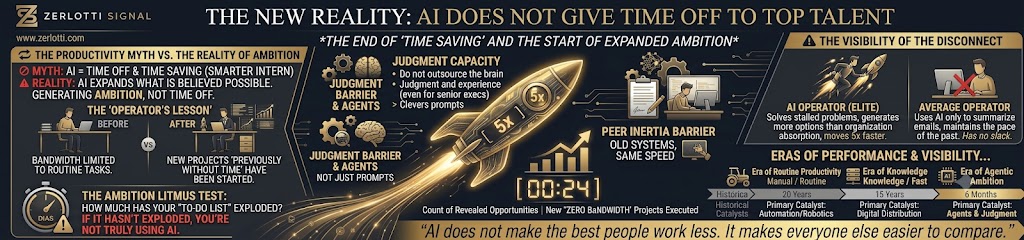
The best AI users I know are not working less. They are working harder. Not because AI failed, because it worked.
A few weeks ago, I was talking with a CEO who told me something that stayed with me. He said the most advanced AI user in his company was also the most overloaded person on the team. This person was producing more than anyone else, moving faster than entire departments, solving problems that had been stuck for months. And somehow, their to-do list kept getting longer. The CEO was confused. "Wasn't AI supposed to give people time back?"
Olha, that is the first misunderstanding.
Most companies still think of AI as a productivity tool. A smarter search bar. A faster intern. Something that helps a person do the same work in less time. That was the first phase, and it was real. People wrote emails faster, summarized documents faster, prepared decks faster. The promise of "AI buys you time" was true at that scale, and it created the comfortable illusion that AI is just a better Office suite.
The next phase is different. AI is leaving the chat box. It is starting to see screens, use browsers, remember context, connect to tools, write code, prepare documents, search files, talk to customers, and move through workflows. It is moving from answers to actions. And when that happens, the most capable people do not simply finish earlier and go home. They start seeing more things they can do.
Think about your company for a second. There are dozens of projects people never start because there is no time. Customer segments nobody analyzes properly. Processes nobody fixes. Reports nobody trusts. Experiments nobody runs. Old systems nobody questions. Sales messages nobody tests. Internal knowledge nobody organizes. Before AI, all of that stayed hidden behind one sentence: "We don't have bandwidth." Now the best people can suddenly do more. So they do.
They run the analysis. They build the prototype. They test the campaign. They rewrite the proposal. They automate the spreadsheet. They compare the contracts. They find the mistake in the process. They ask the next question. And the next question creates the next task. This is the part many executives are missing. AI does not only increase capacity. It increases ambition. Once a good operator realizes they can move five times faster, they do not use that power to do the old job more comfortably. They expand the job.
I see this inside AI-native teams all the time. The people who really know how to use these tools are not sitting there enjoying empty calendars. They are generating more options than the organization knows how to absorb. They are not waiting for a meeting to begin. They arrive with three versions, two alternatives, a working prototype, and a question nobody had thought to ask. This creates a very uncomfortable thing inside companies. The gap becomes visible.
Before AI, the difference between a strong employee and an average employee was real, but often hidden. Everyone had the same meetings, the same systems, the same delays, the same excuses. A great person might move 30% faster, maybe 50%, and the slack in the system absorbed the difference quietly. Now the difference can be absurd. One person using AI well can prepare the work of a small team. Not perfectly. Not magically. But well enough to change the rhythm of the business. And sitting next to them, in the same company, with the same access to tools, someone else is still using AI to summarize emails.
That gap is going to create tension. Not because the AI user is special, but because the work is changing shape around them. Everyone else's pace starts looking like the pace of a previous decade, and there is nowhere to hide it. The Monday meeting that used to be normal now feels like a status report from a slower country.
Here is what most people get wrong: they think the AI advantage is about prompts. It is not. The advantage is judgment. The best users know what to ask, what to ignore, what to check, what to improve, and when the machine is confidently wrong. They are not outsourcing their brain. They are multiplying it. That is why people with experience have a bigger advantage than they realize. A 55-year-old executive who understands customers, contracts, risk, operations and politics can use AI much better than a 25-year-old who only knows how to type clever prompts. But only if that executive actually uses it.
The companies that understand this early will stop asking, "Which chatbot should we buy?" They will ask a better question: "Which people in our company are already operating at a different speed, and what are they teaching us about the future of work?" Because the future will not arrive evenly. It will show up first in one analyst, one product manager, one sales director, one engineer, one assistant, one founder. The person who quietly starts doing the work of three people, then five, then a small department. At first, leadership will admire them. Then leadership will have to explain why the rest of the organization still moves the old way.
This is not a burnout story. It is not a compensation story. It is not a job displacement story. It is simpler than that. AI is revealing that the real constraint in many companies was never the amount of work to be done. It was the amount of work people believed was possible. And once that belief changes, the to-do list explodes.
So look around your company. Who is already moving differently? Who is creating more work because they can now see more opportunity? Who is making the old pace look strange?
AI does not make the best people work less. It makes everyone else easier to compare.